HTTP QUERY: The New HTTP Method That Solves a 16-Year-Old Problem
 Sayan Dey•5 min read•20th Jul, 2026backend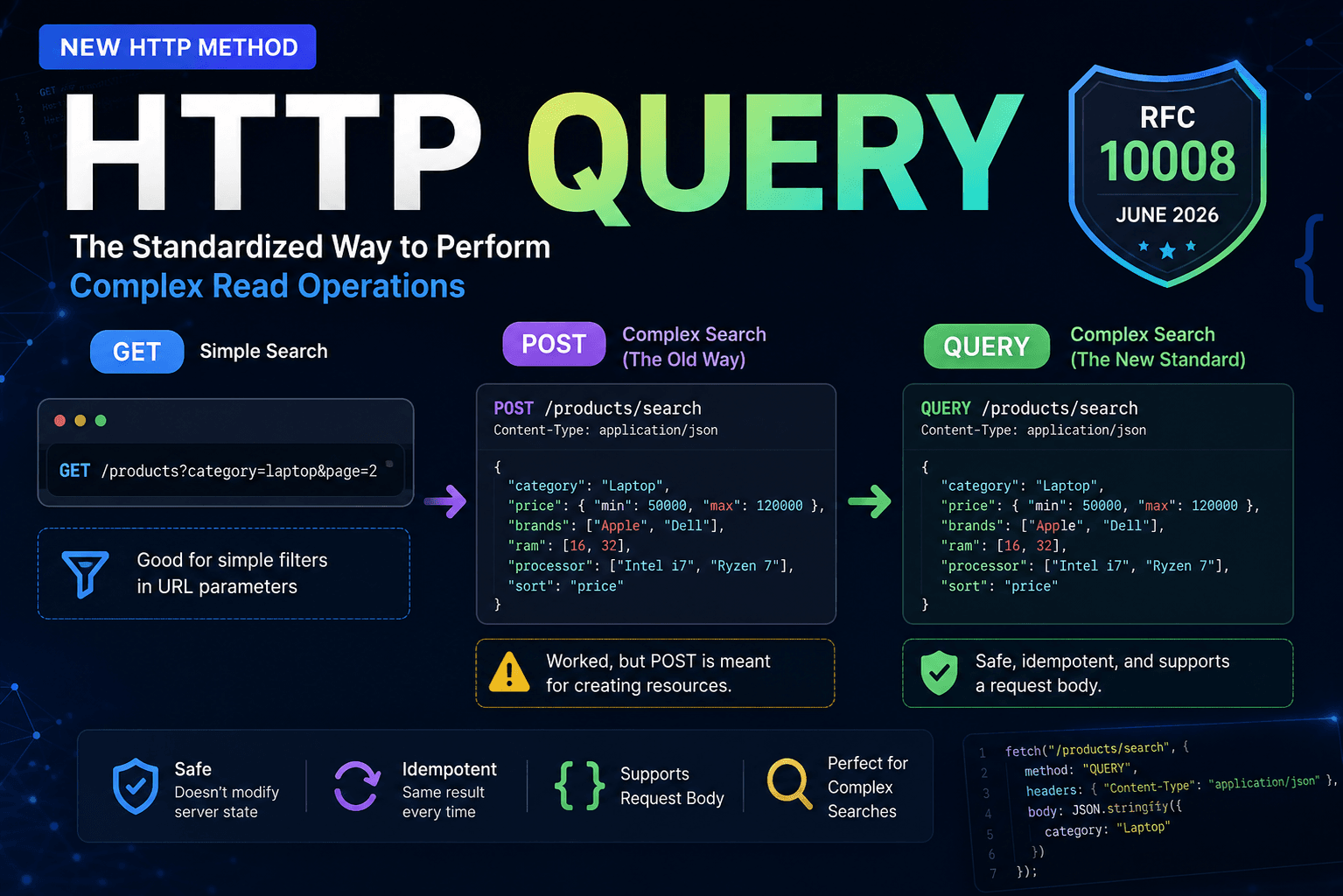
In June 2026, the HTTP QUERY method became an official standard, solving a long-standing problem in REST APIs. Learn why developers relied on POST for complex searches, how QUERY fixes it, and how to implement it in Express, FastAPI, and JavaScript.
If you've ever built a REST API, you've probably done this:
- Used GET for simple searches.
- Switched to POST /search when the filters became too complex.
It worked, but it was never semantically correct.
In June , 2026 , a new HTTP method was standardized , that solved a 16 years old problem among developers.
Previously, there were this REST api methods : GET,POST,PATCH,PUT,DELETE
Last time PATCH was introduced in 2010.
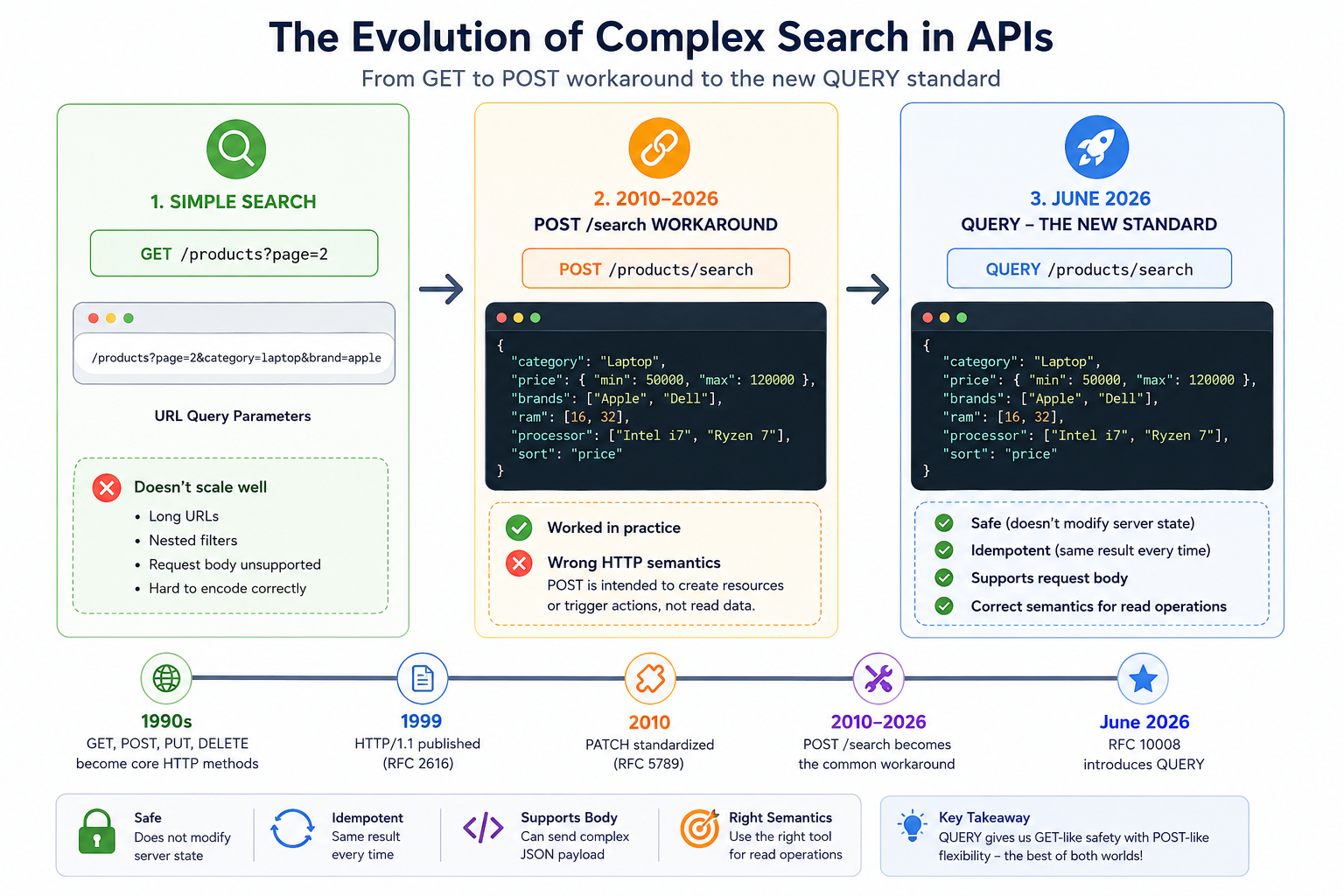
Timeline:
1990s : GET, POST, PUT, DELETE become core HTTP methods
↓
1999 : GET / POST (publication of HTTP/1.1 (*RFC 2616))
↓
2010 : PATCH standardized (RFC 5789)
↓
2010–2026 : POST /search becomes the common workaround
↓
June 2026 : RFC 10008 introduces QUERY
To retrieve data we use GET:
GET /users/10
or
GET /users?dept=dev&page=2
But there is certain limitation.
Problems with GET:
- URLs have size limits (usually 8000 characters max , vary between browsers, servers, proxies, and CDNs.)
- Parameters are visible in logs (security issue)
- Difficult to represent complex, nested search criteria in URL parameters.
- Complex to encode correctly
Previous alternative:
As an alternative for complex queries , developers previously used POST method.
In the body of the post method developers pass the queries which are resolved in the server side.
Example of working with POST
Let's assume , we need to query a product . So, previously we use this way:
POST /products/search
Request body:
This is passed in the server through POST request.
Express server side:
app.post("/products/search", (req, res) => {
    const filters = req.body;
    // search database
    res.json({
         message: "Matching products",
        filters });
});
This technique was Industry standard.But POST is intended to create resources or trigger actions. Searching dose not change server state , making it compromise more than a ideal choice.
Why not send a body with GET?
You might wonder:
GET /products

{
   ...
}
Although the HTTP specification never explicitly forbids a GET request body, its semantics were never standardized. Many servers, proxies, and HTTP clients ignore or reject GET request bodies, making them unreliable in practice.
Now there is QUERY:
The new QUERY method was introduced to solve exactly this problem.
It is:
- Safe (doesn't modify server state)
- *Idempotent (repeating the request has the same effect)
- Supports a request body
*POST is not idempotent
A QUERY request:
QUERY /products/search
Content-Type: application/json
The server performs a search and returns matching products.
-
Nothing is created.
-
Nothing is updated.
-
Nothing is deleted.
Implementing QUERY in express
Express doesn't yet have an app.query() method, but it can still handle custom HTTP methods.
import express from "express";

const app = express();
app.use(express.json());

 app.(,  {
     (req. !== ) {
          ();
    }
     filters = req.; res.({
        : req.,
        filters,
        :
    });
});
Calling QUERY from JavaScript
const response = await fetch("/products/search", {
    : ,
    : {
        :
    },
    : .({
        : ,
        : [, ],
        : ,
        :
    })
});

 data =  response.();

.(data);
A FastAPI Example:
Since many AI services use FastAPI, here's how you can accept a QUERY request.
from fastapi import FastAPI, Request

app = FastAPI()

@app.api_route("/products/search", methods=["QUERY"])
async def search_products(request: Request):
    filters = await request.json()

    return {
        "method": "QUERY",
        "filters": filters
    }
Comparison:
| Feature | GET | POST | QUERY |
|---|---|---|---|
| Reads data | ✅ | ✅ | ✅ |
| Create resources | ❌ | ✅ | ❌ |
| Idempotent | ✅ | ❌ | ✅ |
| Supports request body | ❌ | ✅ | ✅ |
| Safe | ✅ | ❌ | ✅ |
| Best for complex search | ❌ | Common workaround | ✅ |
Small search
↓
GET /products?page=2


Large search
↓
POST /products/search     ← before 2026


Large search
↓
QUERY /products/search    ← after RFC 10008
Although QUERY is now standardized, most frameworks, API gateways, reverse proxies, and API documentation tools are still adding support. For now, you'll continue to see POST /search in many production APIs.
*Notes:
Idempotent: An operation is idempotent if sending the same request multiple times produces the same final state.
GET, PUT, DELETE, and QUERY are idempotent.
PATCH may or may not be idempotent depending on how the server implements it.
POST is generally not idempotent.
RFC (Request for Comments): An RFC is an official technical document published by the Internet Engineering Task Force (IETF) that defines Internet standards and protocols. HTTP, TCP, TLS, and many other core Internet technologies are specified through RFCs. Once an RFC reaches the Internet Standard stage, it becomes an official standard that vendors and developers can implement.
References:
- RFC 10008 — HTTP QUERY Method: https://www.rfc-editor.org/info/rfc10008/
#http#rest#api#query#programming#web-development#backend
325 views