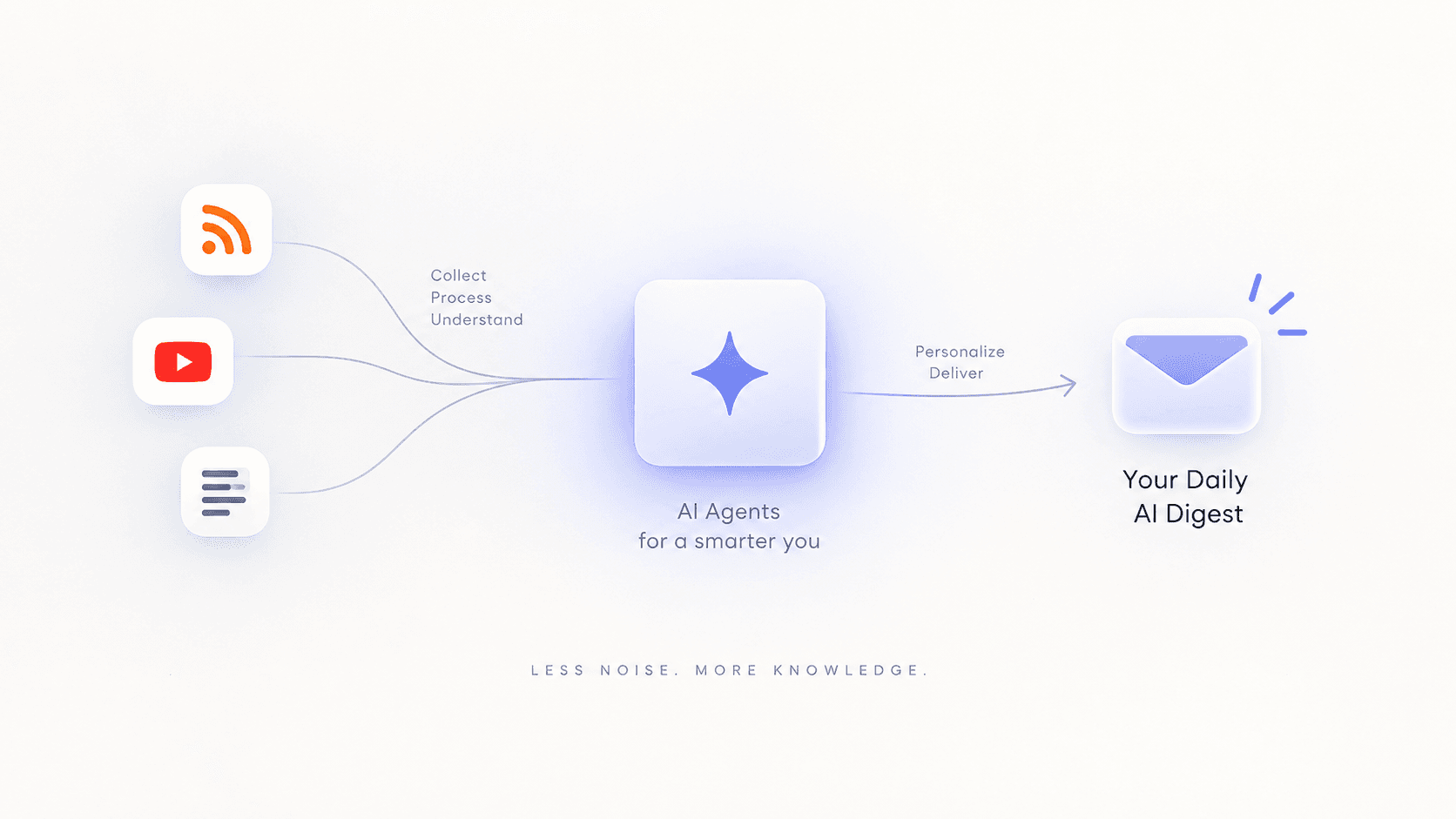
An AI-powered platform that automatically collects, processes, summarizes, ranks, and delivers personalized AI news based on a user's interests and technical profile.
This project is an AI-powered personalized news aggregation system designed to turn a large amount of AI-related content into a concise and personalized knowledge feed.
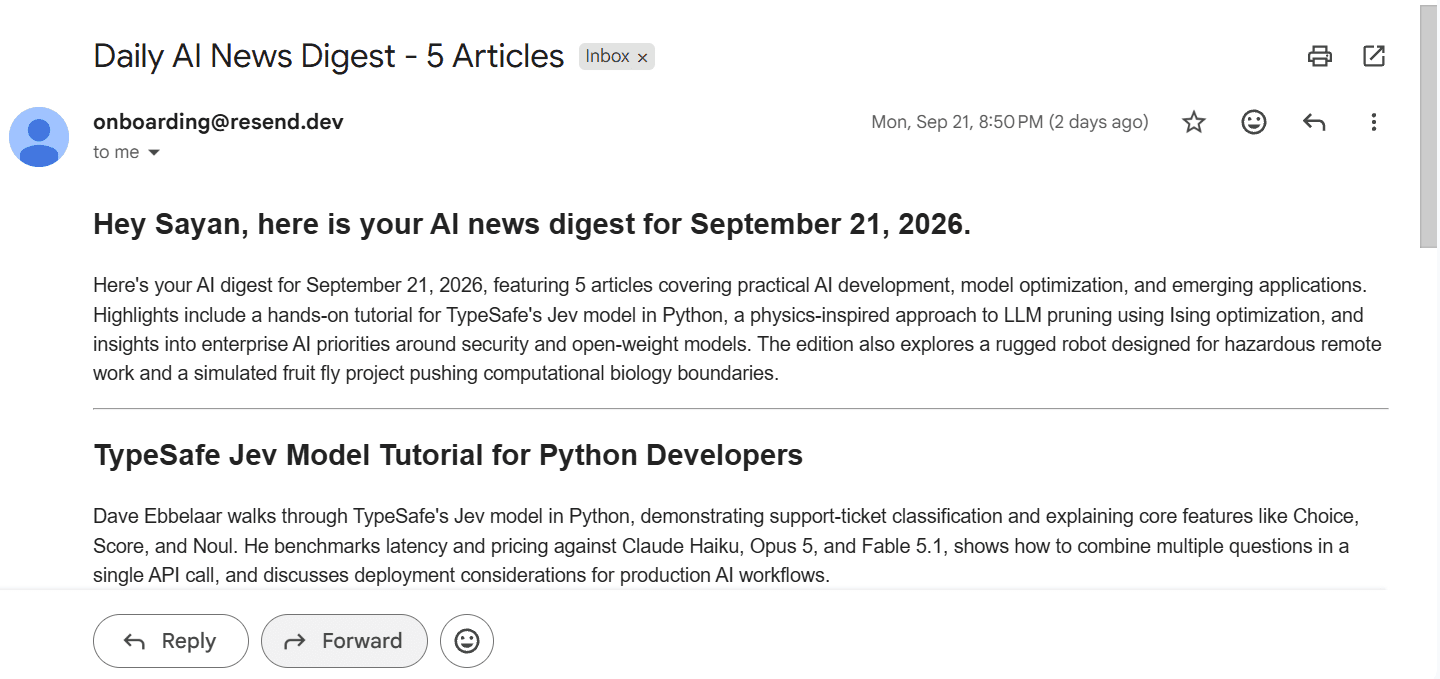
It automatically collects content from RSS sources and YouTube channels, processes the content, generates AI-powered digests, ranks the content according to a user's interests, and delivers the final curated digest through email.
The main goal is not just to collect AI news, but to build an automated pipeline that can discover, understand, personalize, and deliver useful technical information.
The system is divided into separate stages so that scraping, content processing, AI generation, curation, and delivery remain independent components.
3. Content Sources
The system collects AI-related content from 22 sources across RSS feeds and YouTube channels.
RSS Sources
The project currently integrates 16 RSS feeds from major AI companies, research organizations, developers, and AI communities.
Source
Feeds
Anthropic
3
OpenAI
3
Hugging Face
1
Google / DeepMind
2
Meta AI
1
Mistral
1
xAI
1
Ollama
1
The Batch — DeepLearning.AI
1
Simon Willison
1
Cohere
1
Total
16
YouTube Sources
The project also collects content from 6 AI-focused YouTube channels:
Dave Ebbelaar
Matthew Berman
Matt Wolfe
The AI Daily Brief
AI Explained
Two Minute Papers
This combination allows the system to collect information from both official AI sources and independent technical content creators.
4. AI Agents
The project uses three main AI agents, each responsible for a different part of the pipeline.
1. Digest Agent
The Digest Agent converts processed content into a concise and useful digest.
It receives the article content or YouTube transcript and generates:
A concise title
A short summary
Important technical information
Practical and actionable insights
The agent is instructed to focus on meaningful content and avoid unnecessary elements such as navigation, promotional content, social links, and other irrelevant page information.
However, an IP-blocked condition is treated differently.
If the system detects that the IP is blocked, there is no reason to repeatedly retry the same request. The retry loop is immediately stopped and the pipeline continues using the available metadata.
No Transcript Fallback
If a transcript cannot be obtained, the system can still generate a digest using the information available from the YouTube video:
YouTube Video
      │
      ├── Title
      │
      ├── Description
      │
      └── Transcript
            │
            ▼
      Transcript Available?
         /          \
       YES           NO
        │             │
        ▼             ▼
   Full Content    Title +
                   Description
        │             │
        └──────┬──────┘
               ▼
         Digest Agent
               │
               ▼
          AI Digest
When the transcript is unavailable, the title and meaningful description are used as the fallback context.
The model is instructed to generate the digest only from the information available and not invent details that are not supported by the source.
This allows the pipeline to continue processing useful content even when transcript extraction is unavailable.
6. Key Features
Multi-source AI content collection
RSS feeds
YouTube channels
Automated content processing
RSS → Markdown
YouTube → Transcript
LLM-powered digest generation
Structured summaries
Technical insights
Actionable information
Personalized content curation
User-specific profile
Relevance scoring
Ranking
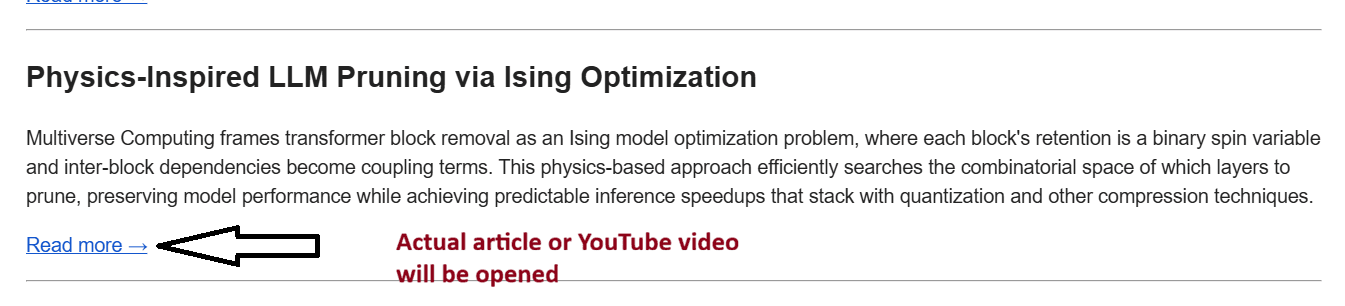
Automated email generation
Personalized introduction
Ranked articles
Original source links
Automated delivery
Email delivery through Resend
Fault-tolerant transcript processing
Retry handling
IP-block detection
Title + description fallback
7. Content Pipeline
The complete processing workflow can be represented as:
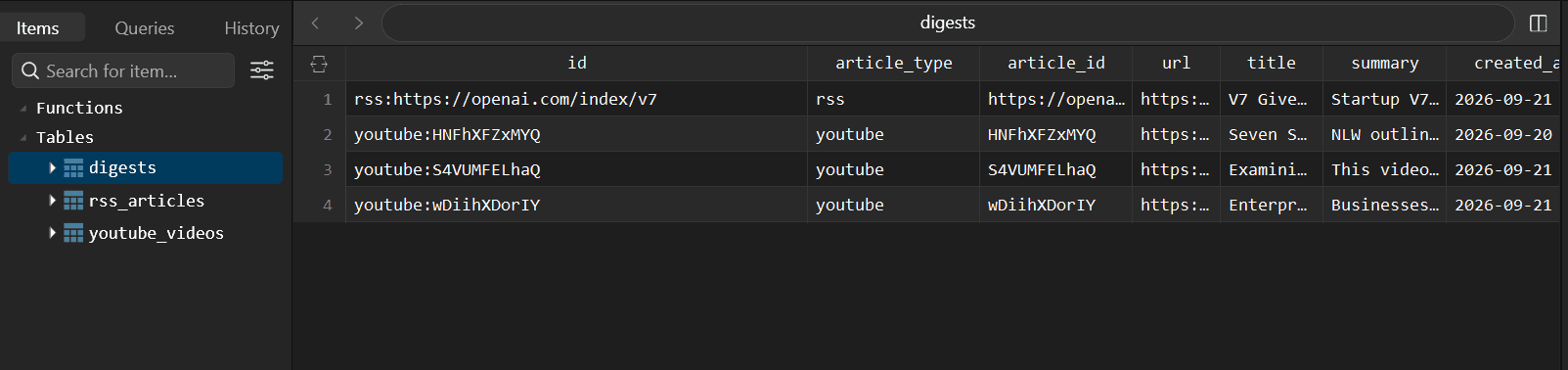
PostgreSQL acts as the persistent storage layer of the application.
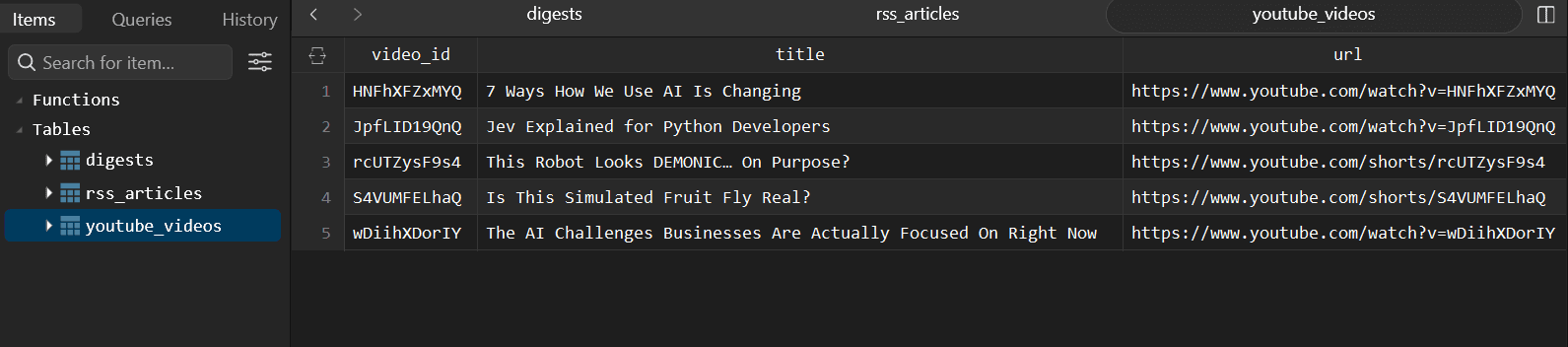
The system stores:
YouTube videos
RSS articles
Processed content
Generated digests
SQLAlchemy is used as the database ORM and repository layer.
This separates the persistent data layer from the scraping, processing, and AI components.
9. Tech Stack
Backend
Python
SQLAlchemy
Pydantic
PostgreSQL
uv
AI & Agents
OpenRouter
LLM APIs
Structured LLM Outputs
AI Agents
Content Sources & Processing
RSS Feeds
YouTube
YouTube Transcript API
Markdown Processing
Infrastructure & Delivery
Docker — PostgreSQL container
Resend — Email delivery
Environment-based Configuration
10. Design Philosophy
The project is built around the idea of turning information overload into personalized knowledge.
Instead of manually visiting multiple AI websites, reading dozens of articles, watching videos, and deciding what is relevant, the system automates the entire process:
Discover
   ↓
Process
   ↓
Understand
   ↓
Personalize
   ↓
Deliver
The project also demonstrates how different AI engineering concepts can work together in a practical application:
LLMs + AI Agents + Backend Systems + Databases + APIs + Automation
The focus is on building a complete AI-powered system rather than using an LLM as an isolated feature.